
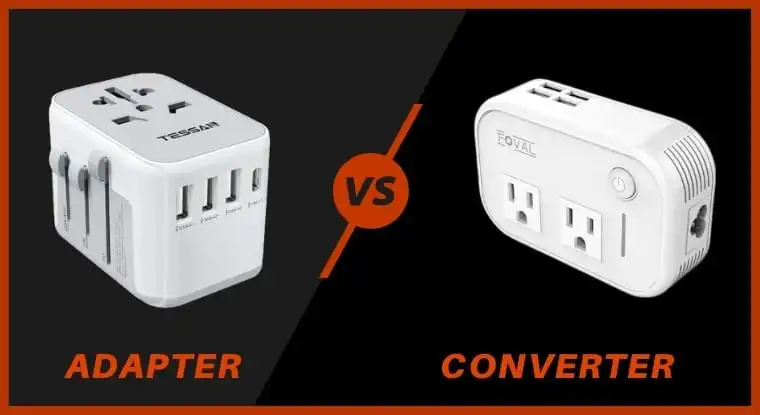
Have you ever traveled with your laptop and other electronic devices but forgot to take your charger?
If yes, you know the importance of a travel adapter or converter.
The funny thing is that not everyone knows the difference between a travel adapter vs. converter. If you’re confused about the two, you’re in the right place!
Nevertheless, it cannot be very clear to understand the basic comparison of these two electronic devices. No worries, we’re here to help you get a clear idea regarding the topic.
Keep reading this article to understand the difference between a travel adapter and a converter in simple terms. Without further ado, let’s get started!
What is a Travel Adapter?
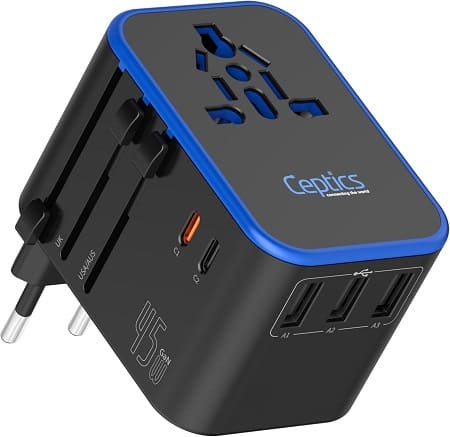
An adapter is an electrical device that allows you to connect one plug type to another. It is commonly used when traveling to countries with different electrical outlet configurations.
For example, a universal travel adapter lets you plug in and charge devices such as smartphones, laptops, tablets, and cameras using different types of wall sockets.
There are several types of adapters on the market, each designed for a specific purpose. These include electrical, video, audio, and network adapters.
One important thing to remember is that a travel adapter only changes the plug connection. It does not convert electrical voltage. This means your device must already support the voltage supplied by the outlet.
Using the wrong adapter usually won’t damage your device by itself, but connecting a device that isn’t compatible with the local voltage can cause serious problems.
if you’re on a tight budget, a universal travel adapter (Universal Travel Adapter Wall AC Power Plug Adapter) would be a more affordable option.
What is a Converter?
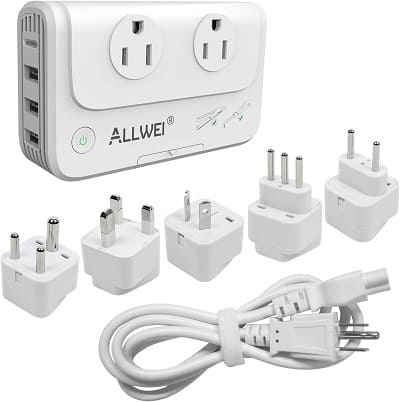
A travel converter is an electrical device designed to change the voltage supplied by a power outlet to match the requirements of your electronic devices.
It is particularly useful when traveling between countries that use different electrical voltage standards.
A travel converter is a convenient option because it is generally compact and easy to pack.
It allows travelers to use certain appliances, such as hair dryers, hair straighteners, curling irons, and other electrical devices that may not support the local voltage.
There are different types of voltage converters available, including step-up and step-down converters. Each is designed for a specific purpose, depending on whether you need to increase or decrease the voltage.
Choosing the right travel converter depends on the appliances you plan to bring, their wattage requirements, and the voltage used at your destination.
Unlike a simple travel adapter, using the wrong voltage converter can damage your appliances or cause overheating and electrical hazards.
Comparison Table of Travel Adapter and Converter
Let’s take a look here to know how these two electronic devices compare to each other.
| Parameters | Adapter | Converter |
| Applications | An adapter charges electronics, including cellphones, computers, cameras, and tablets. | A converter changes the voltage from high to low or low to high for devices like hair straighteners and hair dryers. |
| Categories | Adapters include electrical, video, audio, and network adapters. | Converters include cycloconverters, matrix converters, and DC-link converters. |
| Misuse of Equipment | In certain circumstances, using the wrong adapter may not create any issues. | Using the wrong converter might create serious issues. |
| Components | Has very few components. | Compared to the adapter, a converter is more complicated. |
Travel Adapter vs. Converter: In-Depth Comparison
Both of these devices can be efficient while traveling. However, the main difference between a travel adapter and a converter is the application.
Adapters and converters are the ideal travel-friendly items to bring along since they can be used for numerous reasons. The plug icon converters/stages may vary from their origin. In this way, both gadgets are advantageous.
Usage
Mobile phones, computers, cameras, tablets, and other electronic gadgets can all be recharged with the help of an adapter.
When it comes to hair straighteners, hairdryers, and other appliances, a voltage converter alters the voltage from high to low or low to high.
Types
Both adapters and converters have different ranges and types. For example, adapters come in various shapes and sizes, including electrical, video, audio, and network adapters, to name just a few.
On the other hand, converters such as cyclo converters, matrix converters, and DC-link converters are among the numerous kinds of converters.
Easy Setup
When you go on a trip, you’ll definitely need something easy to set up wherever you are. Having said that, an adapter is easy to carry and install because it has few components compared to a converter.
Adapters vs. Converters: Which one to choose?
When deciding between a travel adapter and a travel voltage converter, keep in mind whether or not you’ll need to convert electrical voltage for any of your electronic gadgets.
For instance, many electronic gadgets, such as laptops and smartphones, can tolerate various charging voltages, while gadgets like hairdryers and electronic toothbrushes can’t handle voltage variations.
Having said that, an adapter enables you to connect your gadgets into a different kind of wall socket than the one they were originally designed for.
It doesn’t affect the amount of power delivered to the appliance. If the appliance you are using can operate at both high and low voltages and frequencies, you won’t need a converter but merely an adapter.
On the contrary, a power converter lowers the voltage of an appliance from 240v to 120v, enabling equipment that is not dual voltage to run at the voltage at which it was built.
Moreover, converters do not alter the frequency at which power is provided, and they should only be used for a maximum of 1-2 hours at a time.
If you now need to make a choice, that’ll depend on your budget and which gadgets you’re carrying with you while traveling.
However, keep in mind one more thing: an incorrect adapter won’t harm your devices. But an incorrect converter can fry your gadgets. So whenever you need to buy any converter, make sure it goes with your electrical devices.
Do Travel Adapters Convert Voltage?
Travel adapters are basic devices that enable a device from one country to another by using a power socket without causing any damage. But they don’t transform energy into any other form.
As a travel adapter doesn’t convert voltage, you must ensure that your appliance can handle the energy from the socket before using it.
FAQs
How can I tell whether my adapter serves as a converter and vice versa?
Most personal electrical devices, such as laptops, come with power bars or AC adapters that are pre-wired to convert 220+ volts down to 110 volts.
If you’re still unsure, search for the word “Input” on the device’s label. And if your PowerBar or AC adapter indicates “100-240V,” it also functions as a voltage converter.
Is using a travel adapter safe?
As popular as it may sound, utilizing a ground plug adapter may be hazardous to the environment and your home’s electrical equipment.
When it comes to older electrical outlets, there are just two slots: the tiny “hot” slot and the large “neutral” slot. An adapter will eliminate that capability, rendering them more susceptible to harm.
How safe are plug adapters over time?
It’s a good rule of thumb to avoid using plug adapters as a long-term solution for upgrading an existing system or bridging the gap between contemporary and older outlets.
However, as long as the house’s electrical system is metallic and grounded, plug adapters are rather safe and may be utilized as necessary.
Do I need an adapter or converter for Europe?
Appliances in the United States operate on 110 volts, but devices in Europe run on 220 volts.
If an item or its plug has a voltage range written on it (such as “110–220”), you’ll be OK in Europe if you have that information. It’s good to alter the voltage switch on certain older appliances from 110 (US) to 220 (Europe).
How do you know if you need a travel converter or adapter?
If you’re going to another area, you’ll almost certainly need to carry an adapter with you. However, you’ll only need a converter if your appliances aren’t dual voltage and compatible with the power in your destination country.
Conclusion
So far, you’ve got all the required information regarding the travel adapter vs. converter.
These two little electrical devices, the adapter and the converter, may be applied for various reasons. Both gadgets are ideal for taking on the road because of their small size and portability.
However, they serve different purposes. Whereas the adapter aids in connecting two devices, the converter aids in the utilization of the current-voltage range by the third-party device connected to it.
When traveling, people like to bring a variety of electronic gadgets, such as cellphones, tablets, computers, hairdryers, and hair straighteners, so these two devices function well if necessary.